

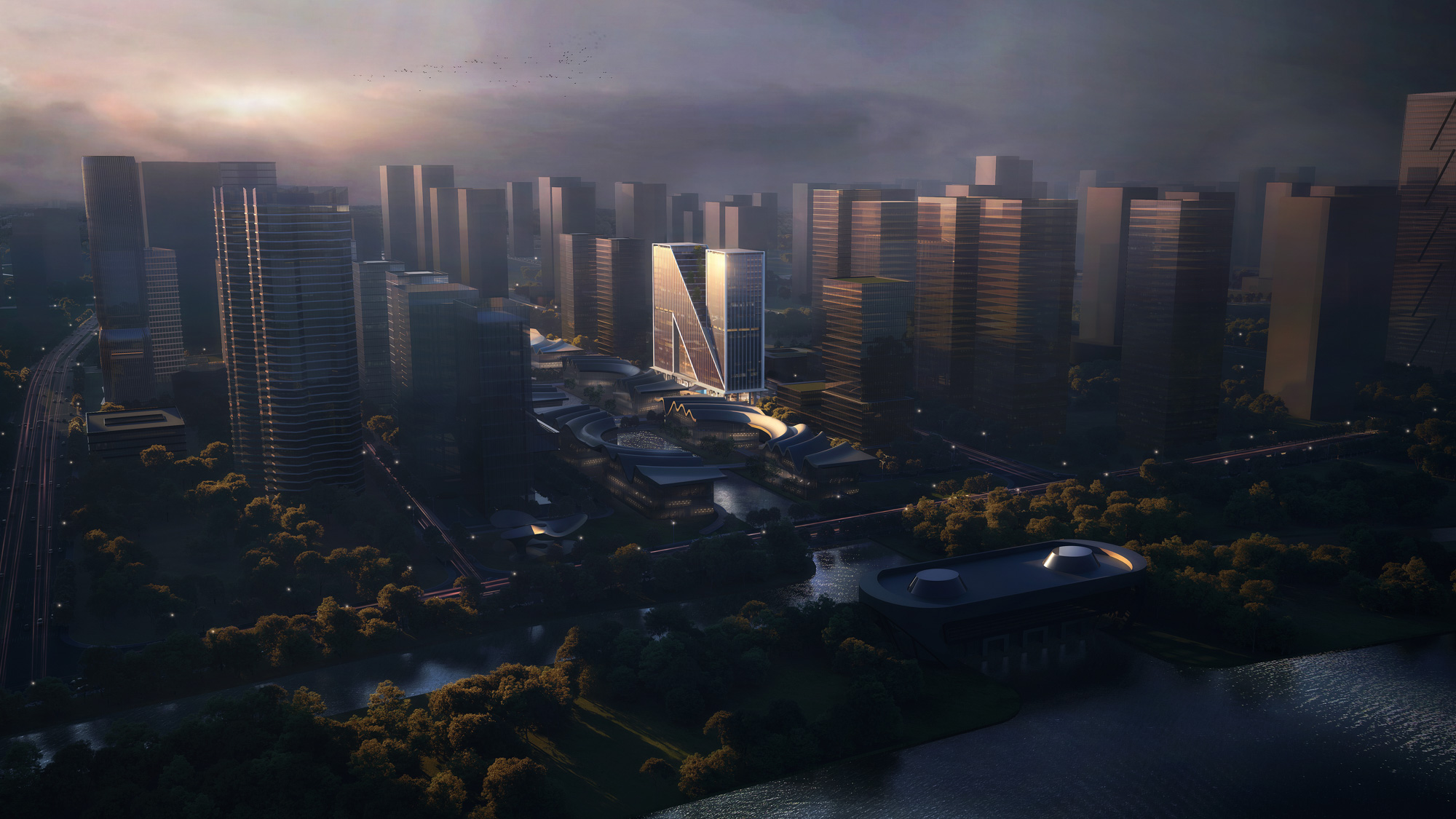
The Southeast Space Frame Global Innovation Center is a corporate headquarters that establishes an urban landmark with a unique 'N-shaped' truss, with architectural scheme design by LYCS Architecture and construction drawings by the Architectural Design & Research Institute of Zhejiang University (UAD). Situated in the core area of Hangzhou's Qianjiang Century City, the project enjoys unobstructed riverfront views along the Qiantang River and the city's primary landscape axis. With a total floor area of approximately 80,000 square metres, the complex integrates offices, conference facilities, exhibition spaces, commercial amenities, and a cloud-level hospitality lounge.

The architecture adopts a dual-tower configuration connected by an inclined truss system, forming a distinctive "N-shaped" layout as its core visual symbol. Derived from the initial letter "N" of the company's name, the form resonates with the corporate identity while symbolising Network, New, Nature, and the infinite possibilities of future development. As a key structural strategy, the diagonal truss creates a suspending-and-supporting system that integrates the two towers into a cohesive whole. It aligns with urban circulation and view corridors while showcasing the Group's expertise in long-span trusses, prefabricated systems, and advanced steel fabrication.

Anchored in a detailed analysis of its urban context, the project responds thoughtfully to surrounding landscapes, neighbourhoods, and skyline conditions. The ground floor is recessed to create a 30-metre north–south visual corridor, linking the Qianjiang Century City Park with the northern arts district and establishing a seamless dialogue between site, city, and nature. Spatial organisation adapts to landscape resources at different heights: below 20 metres, the focus is on street presence and commercial vitality; around 40 metres, views connect to parks and the river system; above 60 metres, the workspaces capture expansive river panoramas. Through massing setbacks, vertical greenery, and rooftop terraces, the design transforms layered urban landscapes into spatial value, forming a full-spectrum interface from street level to the skyline.


Centred on office programmes while integrating exhibition, conference, cloud lounge, and commercial spaces, the project creates a highly consolidated headquarters environment. The standard office floors use a modular layout to support flexible workstations, collaborative areas, and private units. The central connecting volume becomes a signature spatial node, combining an ecological lobby, sky bridge, and multifunctional public platform. The sky atrium is shaped by an all-climate responsive strategy, where stepped massing creates cascading green terraces that work together with vertical planting and a naturally ventilated atrium system to optimise the indoor microclimate. These multi-level setbacks generate a rich sequence of social spaces, seamlessly linking terraces, exhibition areas, meeting rooms and office zones to support diverse modes of interaction and collaboration.
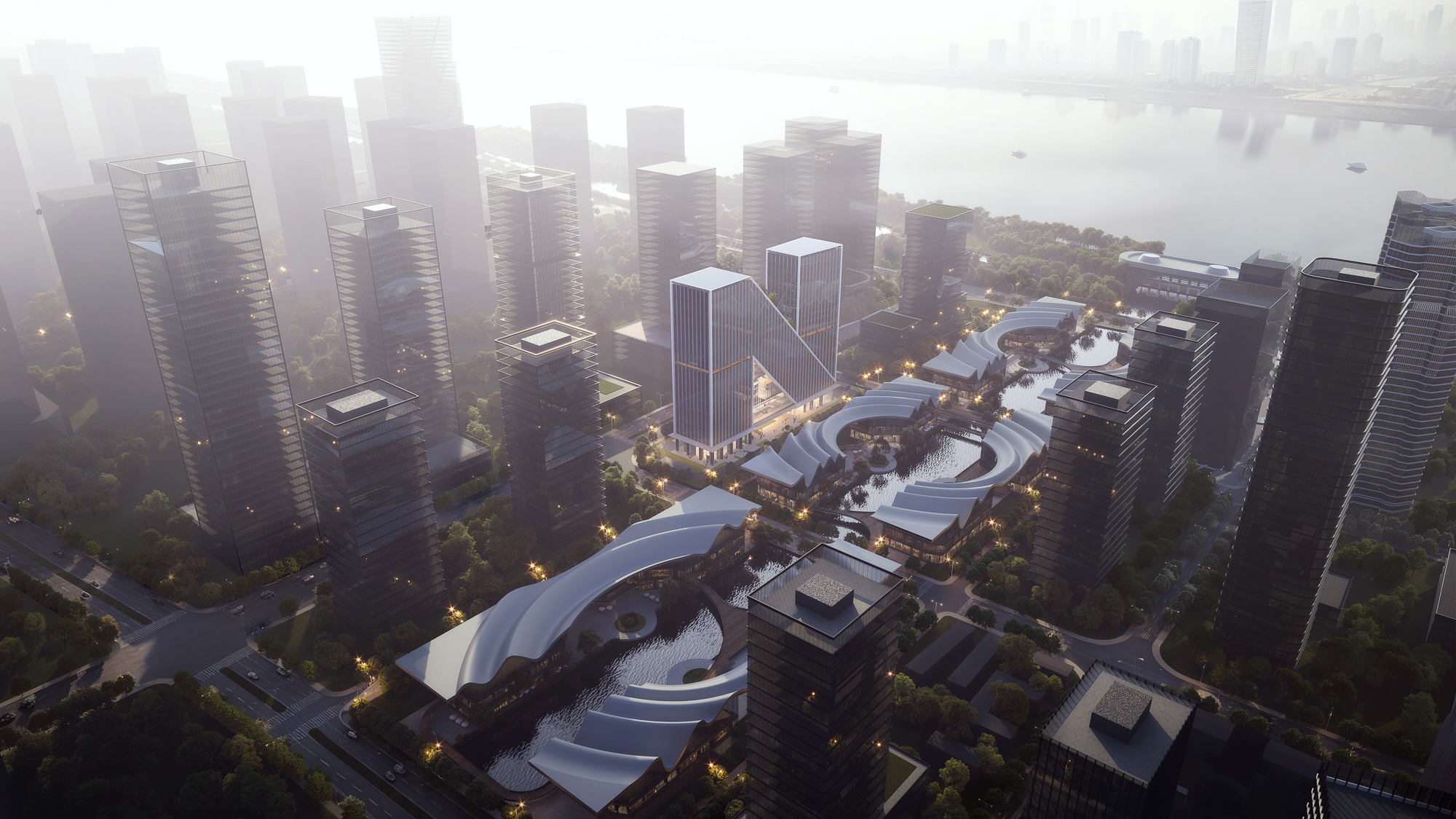
The building's structural system combines reinforced concrete cores with a steel frame, interconnected by a spatial truss that creates the diagonal "N" form. Extending from Level 3 of the North Tower to Level 19 of the South Tower, the truss carries both lateral and vertical loads while creating a generous, open middle zone, the design demonstrates the company's engineering proficiency in steel structure design and implementation. Beyond being a defining architectural feature, the diagonal truss embodies the synthesis of structural logic, corporate identity, and functional organisation, serving as a key driver of the building's generative concept.


